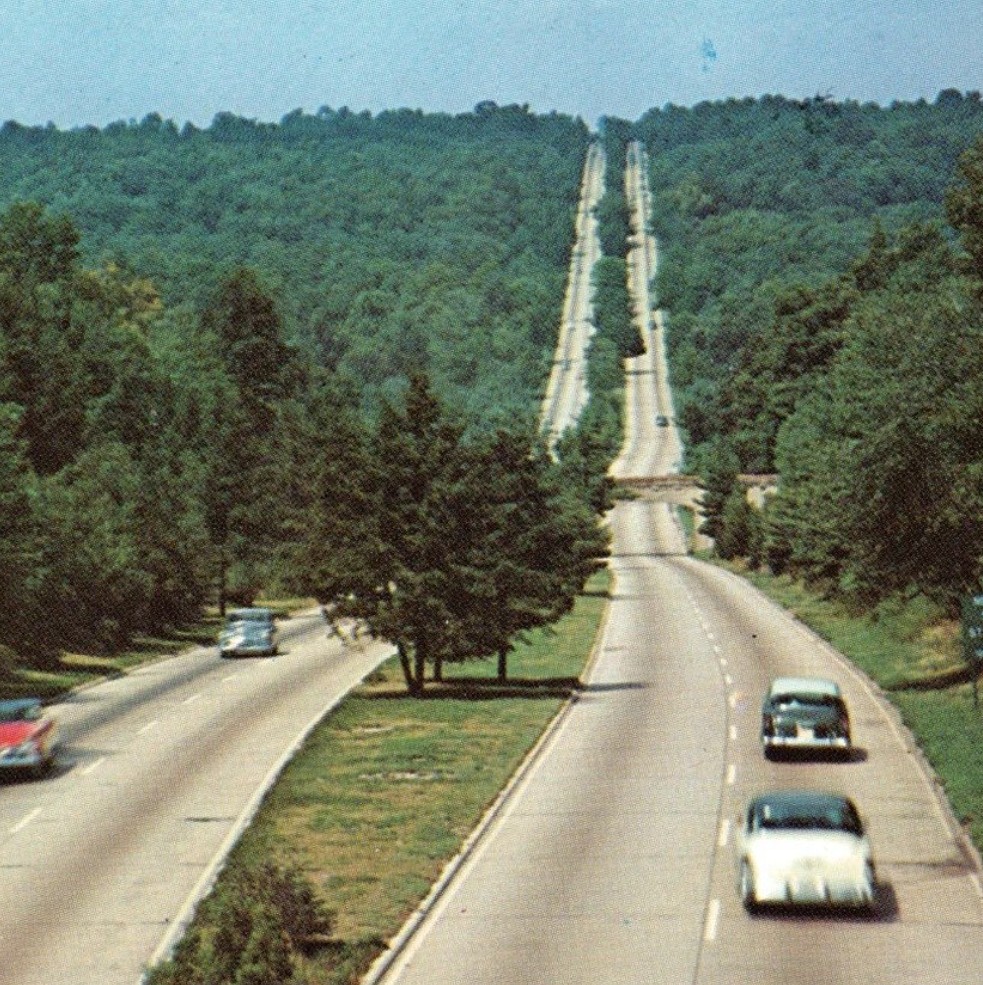
Long before I-95 became Connecticut’s primary coastal highway, the Merritt Parkway was the state’s most important route for travelers between New York and New England. Conceived not just as a highway but as an experience, the Merritt was named after Congressman Schuyler Merritt, who championed its construction as a scenic alternative to the heavily congested U.S. Route 1, also known as the Boston Post Road. At the groundbreaking ceremony in 1934, Merritt emphasized that this road was not merely for speed but for “pleasant transit.” His vision still holds today, as the parkway remains one of the most picturesque roads in the country.
The Need for an Alternative
By the 1920s, the Post Road had become a traffic nightmare. Originally an essential commercial and passenger route connecting New York to New England, it was quickly overwhelmed by the rising number of automobiles. Traffic congestion, frequent stoplights, and deteriorating road conditions made travel slow and dangerous. Efforts to widen and modernize the road were insufficient, leading state officials to consider a parallel highway that would bypass the congestion altogether.
Highway Commissioner John A. Macdonald initially proposed a “superhighway” for passenger cars stretching from Greenwich to New Haven. However, local planners and Fairfield County residents pushed for a different approach—one that emphasized scenic beauty and excluded commercial traffic. This led to the development of the Merritt Parkway as a landscaped, limited-access road, designed to be as aesthetically pleasing as it was functional.
A Depression-Era Public Works Project
The Great Depression created an urgent need for job-creating public works projects, and the Merritt Parkway fit the bill. The parkway employed over 2,000 workers, providing much-needed economic relief to the region. The state justified the expense by arguing that funds allocated to unemployment relief could instead be used to build a lasting infrastructure project that would benefit Connecticut for generations.
Aesthetic and Architectural Innovation
Unlike standard highways, the Merritt Parkway was designed with careful attention to landscape and architecture. Engineer A. Earl Wood and landscape architect Weld Thayer Chase were inspired by Frederick Law Olmsted’s principles of naturalistic landscape design. Their work led to the planting of over 22,000 trees and 40,000 shrubs, enhancing the parkway’s rural character. The bridges, designed by architect George Dunkelberger, became an iconic feature of the road. Each of the 69 bridges was uniquely crafted, incorporating Art Deco, Art Moderne, and even Gothic influences, making the Merritt Parkway a moving art gallery of sorts.
A Scandal That Rocked the Project
Not all aspects of the parkway’s construction were idyllic. The project was marred by a real estate scandal involving land purchases. John Macdonald, keeping the parkway’s route a secret, allowed land speculators—including Darien real estate agent G. Leroy Kemp—to exploit insider knowledge. Kemp and his associates bought land at market rates and resold it to the state at inflated prices, significantly driving up costs. When the corruption was exposed in 1938, Kemp and others were indicted, and Macdonald was forced to resign in disgrace.
Heroes Tunnel: A Unique Engineering Feat
One of the most distinctive features of the Merritt Parkway system is Heroes Tunnel, a twin-tube tunnel carrying Route 15 through West Rock Ridge in New Haven. Originally named West Rock Tunnel, it was completed in 1949 and remains the only highway tunnel to pass beneath a natural land feature in New England. In 2003, it was renamed Heroes Tunnel to honor first responders and military personnel in the post-September 11 era. At 1,200 feet long, the tunnel required significant engineering feats, including extensive ventilation and reinforced concrete construction to support the rock above. Despite its historical significance, modern concerns over aging infrastructure have led to a $200 million investment plan for necessary repairs and expansions.
Opening and Evolution
The first section of the Merritt Parkway opened on June 29, 1938, with a ceremonial ribbon-cutting by Governor Wilbur Cross. Over the next two years, the parkway extended to the Housatonic River in Stratford, where it connected to the Wilbur Cross Parkway. The road quickly became a popular route for motorists traveling between New York and New England, reinforcing Fairfield County’s status as a suburban extension of New York City.
The Merritt Parkway Today
Despite its historical charm, the Merritt Parkway faces modern challenges. Originally designed for slower speeds and smaller vehicles, it now accommodates far more traffic than intended. Since the 1990s, improvements have been made, including widening the road by 16 feet to provide breakdown lanes and allow police to conduct speeding enforcement. Preservation efforts, led by organizations like the Merritt Parkway Conservancy, continue to balance the need for safety improvements with the desire to maintain the parkway’s historic character. The parkway was added to the National Register of Historic Places in 1991, ensuring that any modifications respect its original design.
The Culture of Speeding and Reckless Driving
While the Merritt Parkway was designed for leisurely travel, modern driving habits tell a different story. Known for its tight curves, short ramps, and narrow lanes, the parkway has become infamous for speeding and aggressive driving. Connecticut State Police routinely report drivers reaching speeds over 100 mph, with some cases exceeding 140 mph. Reckless driving incidents, including high-speed pursuits and DUI arrests, have increased in recent years, leading to growing safety concerns among residents and law enforcement. Many drivers weave aggressively through traffic, and the parkway’s lack of shoulders makes evasive maneuvers especially dangerous. While preservation efforts aim to maintain the road’s historic character, balancing safety with its original design remains an ongoing challenge.
The Merritt Parkway remains a rare example of a roadway that is both functional and beautiful—a reminder of an era when infrastructure projects were built not just for efficiency but for enjoyment.
George Cress of Real Broker represents home buyers and sellers throughout Connecticut, with a focus on Fairfield County. He combines technology, local market knowledge, and modern real estate marketing to help buyers keep more of their money and sellers generate greater interest in their homes.
For buyers, George offers flat-fee buyer representation and buyer commission rebates, providing meaningful savings alongside full-service guidance, negotiation, and support through closing. For sellers, he uses property storytelling, video, targeted digital advertising, and one of Connecticut’s largest social media audiences focused on local real estate to reach beyond traditional MLS exposure and attract more qualified interest. Through Co-List with Cress, sellers can add these marketing capabilities while continuing to work with their preferred listing agent.
Explore active Connecticut homes for sale, including listings in Fairfield, Westport, Greenwich, and other Fairfield County communities. To discuss buying or selling a home in Connecticut, contact George Cress.
George Cress
(212) 203-5251
[email protected]
License #RES.0832278
Fairfield County, CT
Real Broker CT, LLC
License #REB.0751297
100 Pearl Street, 14th Floor
Hartford, CT 06103