Silverman’s Farm in Easton began with a young Jewish man from New York City, a serious childhood accident, and a determination to build a life outside the city.
Benjamin “Ben” Silverman grew up in New York with his mother. According to his youngest son, Irv Silverman, Ben was about 14 or 15 when he was run over by a horse and buggy. He spent a long period in the hospital, where doctors wanted to amputate his leg. His mother refused.
Within roughly a year, Irv recalled, Ben was walking normally again.
The accident appears to have helped shape Ben’s desire to leave city life behind. As a young man, he came to Connecticut and began working on dairy farms for about a dollar a day.
The work was difficult, but it gave Ben his first experience with the rural life that would eventually define his family.
From Dairy Farms to Easton
Ben later found better-paying work at Remington Arms in Bridgeport during World War I. Irv remembered his father as wiry and fast, qualities that made him valuable at the factory and helped him avoid being sent into military service.
The job also allowed Ben to save money.
But buying property in Easton presented another obstacle.
Irv said that because his father was Jewish, property owners and real estate agents would not sell land directly to him. Ben ultimately arranged for someone else to purchase the property and then resell it to him for a commission.
That became his first piece of land in Easton.
From there, Ben began building what would eventually become Silverman’s Farm.
The Cider Mill
One of Ben’s first major ventures was a cider mill.
At the time, many families in Easton and neighboring towns had apple trees of their own. They would load apples into trucks, bring them to Silverman’s, and have them pressed into cider.
Irv recalled customers arriving with large barrels and truckloads of apples. Ben charged only a few dollars to press a barrel.
The timing was particularly interesting. The cider mill was operating during Prohibition.
According to Irv, his father also delivered sweet cider to speakeasies in Bridgeport. The cider was legal when Ben delivered it, but after sitting for several weeks, it fermented into hard cider.
That additional business helped Ben establish himself while the farm was still getting started.
For a time, the cider mill was also Ben’s home. He brought his mother from New York to Easton, and the two lived in rooms attached to the mill before the family farmhouse was completed.
Building a Farm by Hand
The landscape surrounding the farm looked very different in those early years.
Much of the hill where Silverman’s sits today was wooded. There were no modern bulldozers or chainsaws available to Ben, and even if there had been, Irv said his father could not have afforded them.
Trees were cut with saws. Horses pulled equipment used to move soil and clear terraces.
Ben expanded gradually, clearing an acre, planting it, and then moving on to the next section.
The result was what farmers of the era called a “truck farm.”
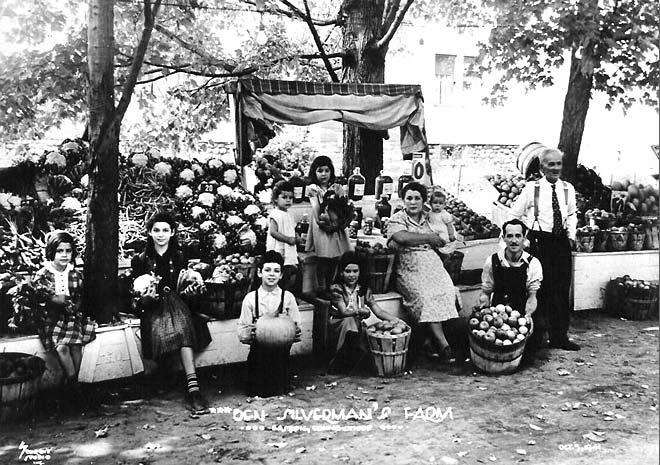
Rather than specializing in one crop, Silverman’s grew almost everything: lettuce, scallions, strawberries, tomatoes, apples, peaches and numerous other fruits and vegetables.
Families would drive into Easton and purchase produce by the bushel, often canning or freezing it for use throughout the winter.
Eight Children and a Growing Farm
As the farm grew, so did the Silverman family.
Ben met Rose Hartz while she was working in Bridgeport, and the two eventually married.
Their farmhouse had an unusual history of its own.
During construction of the Aspetuck Reservoir, homes in the affected area were being sold inexpensively to anyone willing to dismantle and remove them. Ben purchased one, took it apart, and moved it to the farm.
That house became part of the family homestead beside what is now Silverman’s Farm Market.
Ben and Rose raised eight children there.
Farm life was a family operation. The children helped plant crops, pick strawberries, work in the greenhouse and staff the roadside market.
Irv, the youngest of the eight, ultimately became the child who stayed in farming.
From Roadside Farm to Agritourism
Irv attended the University of Bridgeport because it allowed him to continue working on the farm while earning his degree.
Over time, he watched both Easton and agriculture change dramatically.
Earlier generations traveled directly to farms to purchase large quantities of produce. As supermarkets and large stores expanded, consumers began buying smaller quantities and had less direct contact with farms.
Silverman’s had to change with them.
Under Irv’s leadership, the farm increasingly moved toward what is now known as agritourism.
The orchards expanded. Pick-your-own apples and peaches became a major attraction. Tractor rides brought visitors into the fields, and an animal farm gave children the opportunity to see cows, sheep, goats and other animals up close.
For Irv, that transition brought the farm almost full circle.
Children who no longer grew up around agriculture could come to Easton, ride a tractor, pick fruit directly from a tree and see for themselves where food comes from.
The farm had evolved from primarily selling food to also providing an experience.
More Than a Century in Easton
Silverman’s Farm has survived because each generation adapted it to a changing Connecticut.
Ben Silverman transformed wooded land into a working farm with little more than savings, horses and manual labor. His family expanded it into a roadside agricultural business. Irv later helped reinvent it as the pick-your-own and family destination familiar to generations of visitors today.
And the connection to the original family remains unusually tangible.
Irv and his wife Nancy still live on the property, continuing a story that began more than a century ago with a young man determined to make a life for himself in Easton.
Cress is an innovative real estate advisory firm representing buyers and sellers of high-end properties throughout Fairfield County, CT and beyond. On the sell side, Cress delivers marketing-driven support designed to expand visibility and maximize outcomes. Through its co-listing model, Cress partners alongside listing agents to provide digital-first distribution, high-quality content creation, and proactive demand generation strategies that extend well beyond traditional MLS exposure.
On the buy side, Cress offers flat-fee representation and commission rebate programs that bring efficiency and transparency to luxury transactions while maintaining a high standard of service. Known for strategic insight, modern marketing execution, and deep local knowledge, Cress provides a smarter, more aligned approach to buying and selling real estate.
For more information, visit www.callcress.com.
George Cress
(212) 203-5251
george@cress.co
License #RES.0832278
Fairfield County, CT
Real Broker CT, LLC
License #REB.0751297
100 Pearl Street, 14th Floor
Hartford, CT 06103