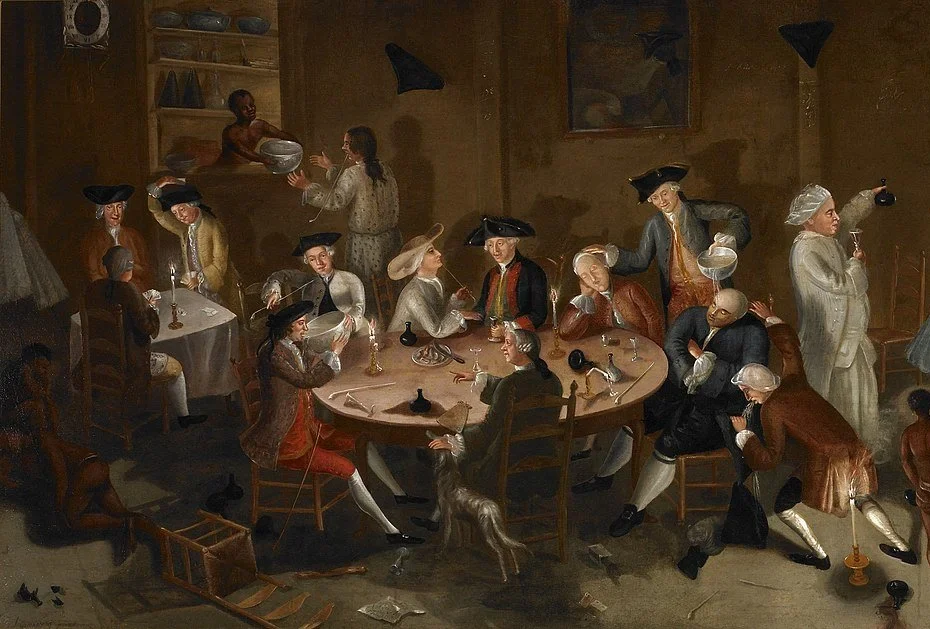
If you checked into a Connecticut tavern 250 years ago, chances are you weren’t sleeping alone. Taverns were essential to travel in colonial America, providing food, drink, lodging, and a place to exchange news at a time when a journey of even a few dozen miles could take most of the day.
The experience bore little resemblance to a modern hotel. Privacy was limited, meals were communal, and travelers from very different walks of life could find themselves under the same roof. Three surviving Connecticut taverns, the Sun Tavern in Fairfield, Keeler Tavern in Ridgefield, and Leffingwell House in Norwich, offer a window into what that experience was actually like.
The Sun Tavern in Fairfield, CT
The Sun Tavern stands in the heart of Fairfield’s historic town center, on property associated with tavern keeper Samuel Penfield. The present building dates to the years following the British burning of Fairfield in 1779, when much of the town was destroyed during the Revolutionary War.
For an overnight traveler, privacy wasn’t necessarily part of the experience. Guests at eighteenth-century taverns commonly shared bedrooms and even beds with people they had never met. Beds could consist of mattresses supported by a lattice of ropes stretched across a wooden frame. Those ropes periodically needed tightening as they loosened and sagged, a practice popularly, though perhaps apocryphally, associated with the expression “sleep tight.”
There were at least a few concessions to comfort. On bitter Connecticut nights, a brass bed warmer filled with hot coals could be passed between the sheets before a guest climbed in. And rather than making a nighttime trip to an outdoor privy, a traveler might use a chamber pot or commode chair nearby.
The Sun Tavern also represents a chapter of Fairfield’s history that predates the surviving building. Samuel Penfield operated an earlier tavern on the property before the British raid.
The Keeler Tavern in Ridgefield, CT
Meals offered another lesson in how different eighteenth-century travel could be. There was no menu in the modern sense. An innkeeper’s household prepared what was available, and guests generally ate together at a common table rather than ordering individual meals. Depending on the season and location, that might include wild game, poultry, hearty stews, bread, root vegetables, seasonal produce, cider, and other locally available foods.
At Ridgefield’s Keeler Tavern, which dates to 1772 and stood along the important road between New York and New England, the communal table was part of the social experience. Travelers could arrive knowing no one and leave having exchanged news and made new acquaintances.
Even the “bar” was more literal than it is today. Alcohol and other valuable stock could be kept behind a physical wooden barrier separating the tavern keeper and his supplies from patrons. The barrier, or bar, eventually lent its name to the familiar feature of drinking establishments.
Keeler Tavern’s most dramatic surviving artifact comes from April 1777. During the Battle of Ridgefield, British forces bombarded the tavern as they fought their way through town. One of the cannonballs remains embedded in the building’s northern corner post today, providing a physical connection to the Revolutionary War.
The Leffingwell House in Norwich, CT
The Leffingwell House takes the story even further back. Its origins date to around 1675, roughly a century before American independence. Over its long history, the property served as an “ordinary,” a period term for a licensed establishment providing travelers with food, drink, and lodging.
That role made places like Leffingwell remarkably democratic by eighteenth-century standards. Farmers, merchants, tradesmen, military officers, stagecoach travelers, and prominent public figures could all pass through the same establishment. Their accommodations and social standing weren’t necessarily equal, but the tavern brought together people who otherwise occupied very different worlds.
The most famous visitor associated with Leffingwell was George Washington. In 1781, as the Revolutionary War approached its decisive final phase, Washington stopped in Norwich while traveling through Connecticut and seeking provisions and supplies for the Continental Army. His presence illustrates the extraordinary range of people an eighteenth-century inn might serve. An ordinary traveler could eat and sleep at an establishment that also welcomed the commander of the Continental Army.
Experiencing Connecticut’s Tavern Culture Today
What survives in these buildings is more than colonial architecture. The bedrooms, hearths, communal spaces, furnishings, and artifacts help reconstruct a world in which travel was slower, considerably less private, and far more social than it is today.
The Sun Tavern, Keeler Tavern, and Leffingwell House have all been preserved and are open to the public through their respective historical organizations. Taken together, they offer something difficult to appreciate from a textbook: the chance to stand inside the kinds of places where Connecticut residents and travelers ate, drank, slept, exchanged news, and experienced the American Revolution as it unfolded around them.
Sponsored by CTVisit.com
George Cress of Real Broker represents home buyers and sellers throughout Connecticut, with a focus on Fairfield County. He combines technology, local market knowledge, and modern real estate marketing to help buyers keep more of their money and sellers generate greater interest in their homes.
For buyers, George offers flat-fee buyer representation and buyer commission rebates, providing meaningful savings alongside full-service guidance, negotiation, and support through closing. For sellers, he uses property storytelling, video, targeted digital advertising, and one of Connecticut’s largest social media audiences focused on local real estate to reach beyond traditional MLS exposure and attract more qualified interest. Through Co-List with Cress, sellers can add these marketing capabilities while continuing to work with their preferred listing agent.
Explore active Connecticut homes for sale, including listings in Fairfield, Westport, Greenwich, and other Fairfield County communities. To discuss buying or selling a home in Connecticut, contact George Cress.
George Cress
(212) 203-5251
george@cress.co
License #RES.0832278
Fairfield County, CT
Real Broker CT, LLC
License #REB.0751297
100 Pearl Street, 14th Floor
Hartford, CT 06103